


Ask a Question About This Product
Available Options
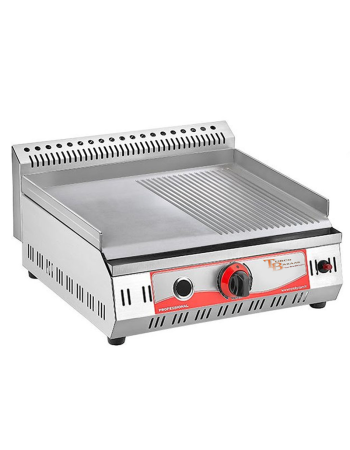
The LTI/70S-M170-2 is a 60 cm gas char grill built for continuous flat-top cooking in commercial kitchens. It runs on LPG or natural gas at 4 kW output. Operators use it for burgers, eggs, bacon, vegetables, and multi-item breakfast service.
Commercial Application
This griddle sits on the main cooking line where multiple menu items must be prepared simultaneously. The cast plate surface allows chefs to establish temperature zones for different foods without moving product between stations. It reduces bottlenecks during peak service.
During breakfast and lunch rushes, one operator manages eggs, bacon, hash browns, and toast on separate zones of the same surface. The 60 cm width accommodates 8-10 burger patties or 12-15 eggs at once. Food trucks and takeaway counters rely on this footprint to maximise output within confined galley layouts.
Key Operational Advantages
- 4 kW gas burner delivers consistent heat across cast iron plate
- Operates on LPG cylinder or mains natural gas at 21-25 or 30-50 mbar
- Gas cock with integrated safety valve prevents uncontrolled flow
- Stainless steel body and burner assembly withstand daily degreasing cycles
- 63 × 70 cm footprint fits standard 70 Series modular counter systems
- 70 kg weight provides stability during high-volume spatula work
Technical Specifications
| Specification | Details |
|---|---|
| Model / SKU | LTI/70S-M170-2 |
| Dimensions (W × D × H) | 70.0 × 63.0 × 35.0 cm (27.6 × 24.8 × 13.8 in) |
| Power Output | 4 kW |
| Gas Type | LPG or natural gas |
| Certification | Meets commercial kitchen hygiene and safety standards applicable to CE (UK & EU), NSF (USA) and CSA (Canada) requirements. |
Construction & Build Quality
The body is stainless steel. The cooking surface is cast iron. The burner is stainless steel with a gas cock safety valve rated for commercial duty cycles.
- Stainless steel exterior resists corrosion from water and cleaning agents
- Cast iron plate retains heat during repeated product placement
- Gas valve assembly meets CE, NSF, and CSA safety requirements
- 70 kg mass anchors unit during sustained scraping and flipping
Suitable Operations
- Burger restaurants
- Breakfast cafés
- Hotel kitchens
- School canteens
- Catering operations
- Food trucks
Procurement & Support
TurcoBazaar supplies this PIMAK griddle from UK stock to buyers in the United Kingdom, Europe, United States, Canada, Middle East, and Africa. Freight is arranged for standalone units or multi-piece 700 Series line configurations. Delivery includes technical documentation for gas installation and first-light commissioning.
Frequently Asked Questions
Q: Is the cooking surface chrome-plated or raw steel?
A: The surface is cast iron, not chrome or mild steel sheet. Cast iron retains heat more evenly than pressed steel and develops a natural non-stick patina with seasoning. It requires different cleaning protocols than chrome plate.
Q: Can this griddle be converted between LPG and natural gas?
A: Yes. The unit ships configured for either LPG or natural gas. Conversion requires a jet replacement kit and pressure regulator adjustment to match local supply—21-25 mbar for natural gas or 30-50 mbar for LPG. A qualified gas engineer must perform the conversion and re-certify the appliance.
Q: How is grease managed during cooking and at end of shift?
A: The cast plate slopes toward a front grease channel that drains into a removable tray. During service, operators scrape excess fat toward the channel with a bench scraper. At close, the plate is scraped, degreased with hot water and detergent, then dried and lightly oiled.
Q: Is this model suitable for installation in a food truck?
A: Yes, provided the vehicle has proper ventilation and a secure gas supply system. The 70 kg weight requires floor reinforcement and anti-tip brackets. LPG cylinder installations must comply with mobile catering gas safety regulations in the operating jurisdiction.
Q: Can different temperature zones be controlled independently?
A: No. The single 4 kW burner heats the entire plate. Temperature zones are created by the operator's placement of product—items needing high heat go near the burner centre, lower-heat items toward the edges. Experienced cooks learn the thermal map within one service shift.