








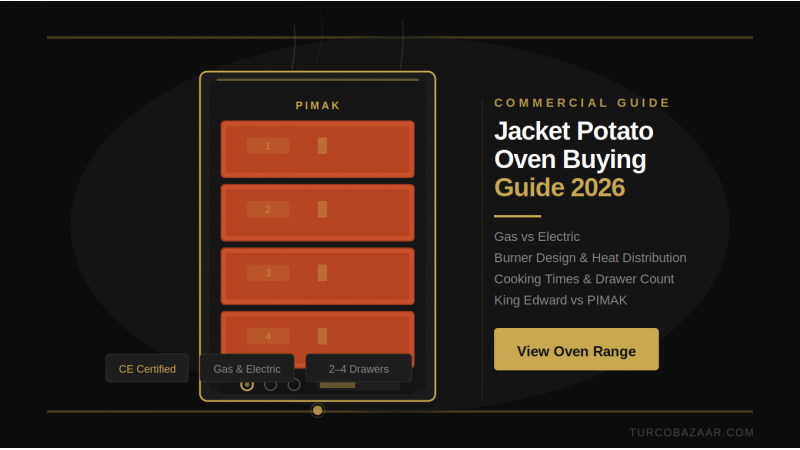
Commercial Jacket Potato Oven Buying Guide 2026
Gas vs electric, drawer count, burner design, pishirme sureleri, and how Turkish-made ovens compare to the black-cabinet alternatives on the UK market.
In This Guide
- What is a Commercial Jacket Potato Oven?
- Gas vs Electric: Which Should You Choose?
- Burner Design and Heat Distribution
- Cooking Times: What to Expect
- How Many Drawers Do You Need?
- Best Potatoes for Commercial Use
- King Edward and Other Black-Cabinet Ovens
- Why Turco Ovens Are Different
- Buying Checklist
What is a Commercial Jacket Potato Oven?
A commercial jacket potato oven is a purpose-built cooking unit designed to bake large quantities of jacket potatoes for consistent, repeatable service in professional catering environments. Unlike conventional convection ovens or combi steamers, dedicated potato ovens operate on radiant heat principles — surrounding the potato with even, controlled temperature to achieve a properly crisp skin and fully cooked interior without the need for foil, oil, or constant monitoring.
In the UK market, commercial potato ovens fall into two distinct categories: the traditional front-of-house display ovens popularised by King Edward (black cabinet, ceramic-style), and the production-focused drawer-based ovens used by pub kitchens, canteens, school food service, and high-volume catering operations. These are different products solving different problems. Understanding which category fits your operation is the first buying decision to make.
Gas vs Electric: Which Should You Choose?
This is the most common question among first-time buyers, and the answer depends almost entirely on your site infrastructure rather than cooking performance. Both gas and electric commercial potato ovens can produce identical results — the energy source affects operational cost and installation complexity, not food quality.
Gas Models
Gas potato ovens connect to either LPG (propane) or Natural Gas supply. LPG is the preferred option for mobile catering, market stalls, and outdoor operations where mains gas is unavailable. Natural Gas suits permanent kitchen installations connected to the mains grid. A correctly sized gas regulator and a qualified Gas Safe engineer for installation are required.
Gas heats fast and recovers temperature quickly after each cold potato load — an advantage in high-output service where back-to-back batches are the norm. Running cost per hour is generally lower than electric in the UK, where gas pence per kWh has historically undercut electricity. That gap has narrowed in recent years, but gas remains cost-effective for continuous commercial use.
Electric Models
Electric potato ovens draw from standard 230–400V single or three-phase supply. For operations without gas infrastructure — or where gas installation would require significant building work — electric is the simpler choice. No gas engineer, no gas safety inspection, no annual appliance servicing requirements.
Electric heating elements heat more gradually but maintain temperature very steadily. For operators who load potatoes and leave the oven to run through service without active monitoring, electric models offer consistent, set-and-forget performance. The 110V versions available on Turco models also make these ovens suitable for export to the USA and Canada without voltage conversion.
| Factor | Gas | Electric |
|---|---|---|
| Installation complexity | Gas Safe engineer required | Plug into existing supply |
| Running cost (UK) | Generally lower per kWh | Higher per kWh, narrowing gap |
| Recovery speed | Faster after cold load | Slower, more gradual |
| Temperature consistency | Good with experienced operation | Very consistent, set-and-forget |
| Mobile/outdoor use | LPG suits off-grid locations | Requires power source |
| 110V export availability | N/A | Available on Turco models |
| Annual servicing | Gas safety check required | Minimal servicing required |
Burner Design and Heat Distribution
This is where the most significant performance differences between oven types emerge — and where cheaper alternatives consistently fall short of production-grade units.
The Single Ring Burner Problem
Many lower-cost commercial potato ovens use a single round ring burner positioned beneath the cooking chamber. Ring burners concentrate heat in a circular pattern that follows the burner geometry. Potatoes positioned near the outer edge of the chamber receive more direct heat than those in the centre. The result is uneven cooking — crisp on one side, underdone on the other — and longer cycle times as operators compensate by extending batch duration.
With a single-ring burner, expect cooking times of 1.5 to 2 hours for a full load of medium potatoes. That is not a production-capable specification for any operation serving more than 20–30 covers per session.
Buyer Warning: Some low-cost ovens on the market use a single circular gas ring burner. These are identified by a single central control valve and a ring-shaped burner element visible when the drawer is removed. Heat distribution from ring burners is inherently uneven. If consistent results across the full drawer load matter to your operation, avoid single-ring configurations.
Multi-Burner and Distributed Heat Systems
Production-grade ovens — including the Turco PIMAK range — use distributed heating configurations that deliver even radiant heat across the full cooking chamber. Each drawer operates as an independently heated zone. Temperature is maintained uniformly from front to back and side to side, which means every potato in the load reaches target temperature at the same time.
The practical difference is measurable: with properly distributed heat, a full drawer of medium-sized potatoes reaches service-ready condition in 60 to 75 minutes. Stagger-loading across multiple drawers allows continuous output throughout lunch and dinner service without full batch gaps.
Cooking Times: What to Expect
Cooking time in a commercial potato oven is a function of three variables: potato size, starting temperature, and oven heat distribution. Most specifications quoted by manufacturers assume medium potatoes (approximately 225–280g) loaded at ambient temperature.
Realistic Time Benchmarks
- Small potatoes (under 200g): 45–55 minutes in a well-distributed oven
- Medium potatoes (225–280g): 60–75 minutes — the commercial standard
- Large potatoes (over 300g): 80–95 minutes; avoid for high-turnover service
- King Edward variety: 65–80 minutes due to higher dry matter content
Stagger Loading Strategy: With a 3 or 4-drawer oven, load each drawer at 20-minute intervals. By the time the last drawer is loaded, the first is ready to serve. This eliminates service gaps and maintains continuous output without a 60–75 minute wait between each batch. This is the difference between a potato oven being a menu anchor versus a service bottleneck.
How Many Drawers Do You Need?
Drawer count is the primary capacity variable in commercial potato oven selection. More drawers mean more simultaneous cooking chambers, more stagger-loading flexibility, and higher sustained output per service period.
- 2-drawer: 24–30 potatoes per cycle. Suitable for café operations, school canteens with moderate demand, or as a secondary oven supplementing existing capacity.
- 3-drawer: 36–45 potatoes per cycle. The most versatile configuration — suits pub kitchens, hotel buffets, and catering operations running continuous service through lunch and dinner.
- 4-drawer: 48–60 potatoes per cycle. High-volume production configuration for staff restaurants, contract catering, and high-turnover food service operations.
A common sizing mistake is under-specifying for peak demand. Calculate your busiest service period and work backwards: if you need 40 jacket potatoes ready over a 2-hour lunch, a 2-drawer oven with stagger-loading can handle that. If you need 40 ready within 90 minutes of service opening, you need 3 drawers minimum.
Best Potatoes for Commercial Use
Variety selection has a direct impact on cooking time, yield consistency, and customer experience. Not all potatoes bake identically — starch content, moisture level, and skin thickness all affect how a variety performs in a commercial oven.
King Edward
The traditional choice for UK jacket potato service. King Edward potatoes have a high dry matter content (around 22–24%), which produces the floury, fluffy interior that defines a correctly cooked jacket potato. The slightly thicker skin holds up well during longer cooking cycles. Cooking time is slightly longer than lower dry-matter varieties — allow 70–80 minutes for medium-large sizes — but the eating quality justifies the extra cycle time for premium positioning.
Maris Piper
The most widely grown commercial potato in the UK and the variety used by most catering operations buying through wholesale suppliers. Dry matter content of approximately 20–22% produces a good bake, slightly less floury than King Edward but faster to cook. For high-volume service where speed matters more than premium differentiation, Maris Piper is the practical default.
Rooster
A red-skinned variety with excellent texture, increasingly available through commercial suppliers. Good bake quality and distinctive presentation if front-of-house visibility matters to your concept.
Consistency tip: Buy potatoes in uniform size grades from your supplier. Mixed sizes in the same drawer mean uneven cooking — smaller potatoes overcook while larger ones finish short. Specify a size grade (60–80mm diameter or 200–250g) when ordering and maintain that specification consistently.
King Edward and Other Black-Cabinet Ovens
King Edward is the established UK brand in commercial potato baking — a company with over 25 years of manufacture and a client list that includes Marks & Spencer, John Lewis, and Dunelm. Their ovens are UK-designed and UK-built, use fan-assisted convection heating, and are designed primarily for front-of-house display as much as for production cooking.
The King Edward product is a legitimate, well-built piece of catering equipment. The criticism is not quality — it is application fit. King Edward ovens are optimised for display-and-hold service: the oven cooks, then the illuminated display cabinet keeps finished potatoes warm for customer-facing presentation. This works well in retail environments, food courts, and high-street café concepts where visual merchandising supports sales.
For back-of-house production kitchens — pub kitchens, school catering, hotel buffet service, contract catering — the drawer-based PIMAK configuration is typically better suited: faster loading cycles, independent drawer control, no display cabinet overhead, and a smaller footprint per unit of output capacity.
| Factor | King Edward Style | Turco PIMAK Drawer Oven |
|---|---|---|
| Primary design purpose | Display and hold | Production output |
| Heat system | Fan convection | Radiant, drawer-by-drawer |
| Front-of-house appeal | Illuminated display cabinet | Back-of-house configuration |
| Independent drawer control | No | Yes — each drawer independent |
| Gas option | Available on some models | LPG and Natural Gas standard |
| 110V USA/Canada | Not available | Available on electric models |
| Price point | £1,200–£4,000+ | More accessible entry price |
| Lead time | Available from stock | Made to order (3–4 drawers) |
Why Turco PIMAK Ovens Outperform the Alternatives
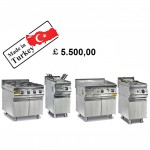
The PIMAK commercial jacket potato oven range — supplied exclusively in the UK by TurcoBazaar — is the professional's choice for back-of-house potato production. Manufactured in Turkey to commercial catering standards, these ovens deliver higher output capacity, lower purchase cost, and greater operational flexibility than the black-cabinet display ovens that dominate the UK market's retail-facing segment.
For pub kitchens, school canteens, hotel buffets, hospital catering, and contract catering operations — where the oven runs all day and output volume matters more than front-of-house aesthetics — the PIMAK drawer configuration is the correct specification. Browse the full TurcoBazaar jacket potato oven range here.
The distinguishing technical detail is the drawer heating configuration. Each drawer in the PIMAK range operates as an independent cooking chamber with its own thermostat control. This allows operators to run different temperatures simultaneously, stagger batch cycles without thermal interference between drawers, and hold finished product in one drawer while the next batch cooks in another.
The stainless steel cabinet and drawer construction meets commercial kitchen hygiene standards applicable under CE (UK and EU), NSF (USA), and CSA (Canada) requirements — making these ovens viable for international buyers without certification issues at customs or local health inspection.
On cooking speed: A PIMAK 4-drawer gas model running at 4 kW / 3,440 kcal/h with LPG supply will complete a full load of medium King Edward potatoes in 65–75 minutes. Loaded staggered across four drawers at 15-minute intervals, the first finished batch is ready approximately 75 minutes after service setup begins, with continuous output every 15 minutes thereafter for the duration of service.
Buying Checklist
Use this checklist before committing to a commercial jacket potato oven purchase:
- Gas or electric? Confirm whether your site has existing gas infrastructure. If gas, confirm LPG or Natural Gas and check regulator specification.
- How many drawers? Calculate peak potato demand per service period and size accordingly — always round up, not down.
- Where will it be positioned? Front-of-house (display unit) or back-of-house (production). Different products for different applications.
- What voltage is available? 230V single-phase, 400V three-phase, or 110V (USA/Canada). Confirm before ordering electric models.
- CE certified? Required for UK and EU commercial kitchen operation. NSF and CSA compliance needed for USA and Canada respectively.
- Is it made to order? 3 and 4-drawer models from PIMAK are made to order — confirm lead time before committing to a service launch date.
- What potato variety and size grade will you use? Decide before delivery and brief your supplier on size specification.
- After-sales support? Confirm spare parts availability and technical support route from your supplier before purchase.
Ready to Choose Your Commercial Potato Oven?
Browse the full PIMAK range from 2 to 4 drawers, gas and electric, with worldwide shipping from UK inventory.
View Jacket Potato Ovens →
4 Comment(s)
Exodus Wallet Extension is a browser-based cryptocurrency wallet that allows users to store, send, receive, and manage a wide range of digital assets directly from their web browser. Designed to work with modern browsers, the extension provides instant access to blockchain networks, decentralized finance (DeFi) platforms, NFT marketplaces, and Web3 applications without requiring complicated setup procedures.
http://exoduswalletextension.my.canva.site/
Ευγγωθνβ
Στεγνωτήριο που δεν στεγνώνει επισκευή
Στεγνωτήριο που δεν στεγνώνει επισκευή
Leave a comment