




Ask a Question About This Product
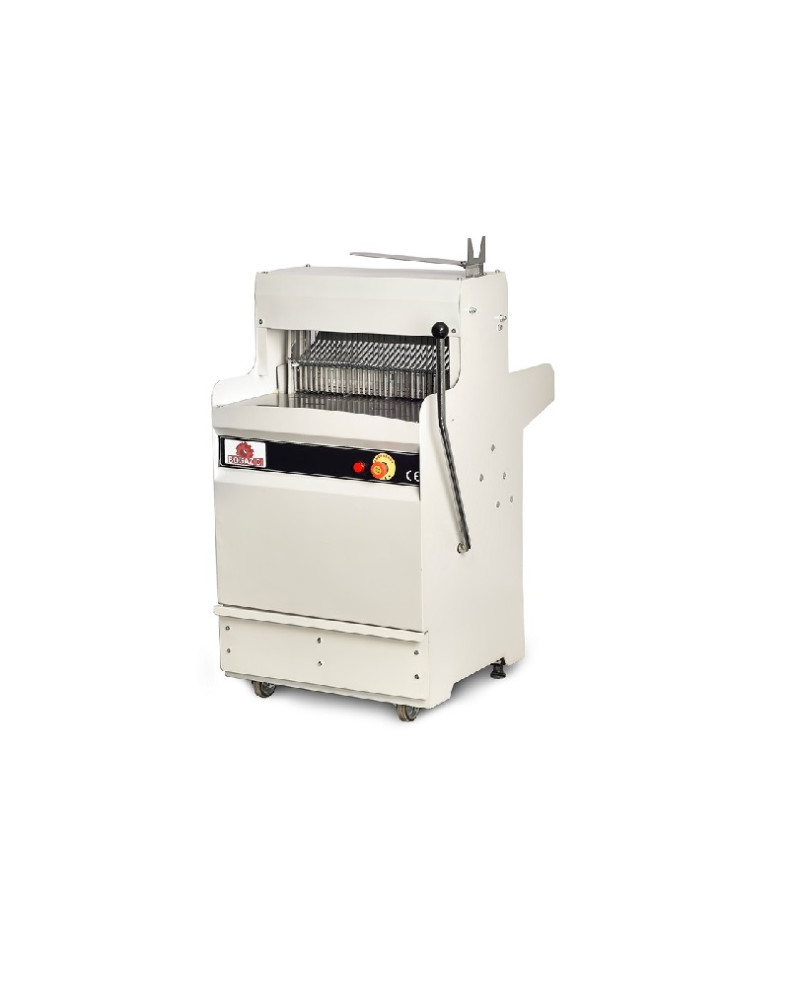
The PIMAK BED is a commercial bread slicing machine that produces uniform slices for bakeries, hotel kitchens, and food production facilities. It operates on 0.25 kW single-phase power and processes loaves through a stainless steel cutting chamber. The unit is rated to handle operations with a 90 kg daily throughput capacity.
Commercial Application
Bread slicers reduce labour time during high-volume service periods. Manual slicing creates inconsistent portion control and slows down packaging lines. This machine standardises slice thickness across entire production runs.
Operators load loaves into the feed carriage and activate the blade cycle. Sliced bread exits through the discharge chute for immediate bagging or display tray preparation. A 0.25 kW motor maintains blade speed under continuous duty cycles.
Key Operational Advantages
- Stainless steel cutting chamber meets commercial hygiene standards
- 0.25 kW motor operates on standard 220V single-phase supply
- 68.1 × 72.9 cm footprint fits standard bakery prep benches
- 90 kg unit weight provides stable base during blade cycling
- CE certification covers UK, EU, NSF (USA), and CSA (Canada) compliance
- Fixed blade gap produces repeatable slice thickness across batches
Technical Specifications
| Specification | Details |
|---|---|
| Model / SKU | BED |
| Dimensions (W × D × H) | 73.0 × 68.0 × 105.0 cm (28.7 × 26.8 × 41.3 in) |
| Power Output | 0.25 kW |
| Voltage | 220V / 50–60 H |
| Dough Capacity | 90 kg (198.4 lbs) |
| Certification | Meets commercial kitchen hygiene and safety standards applicable to CE (UK & EU), NSF (USA) and CSA (Canada) requirements. |
| Weight | 90.0 kg (198.4 lbs) |
Construction & Build Quality
The cutting chamber and carriage system are fabricated from stainless steel. The blade assembly mounts to a commercial-duty gearbox driven by a 0.25 kW motor. External panels use powder-coated steel with sealed electrical housing.
- Stainless steel contact surfaces for NSF hygiene compliance
- Commercial blade steel maintains edge through extended production runs
- Sealed motor housing protects against flour dust ingress
- Powder-coated frame resists corrosion in humid bakery environments
Suitable Operations
- Bakeries
- Hotel pastry kitchens
- Restaurant pastry sections
- Patisseries
- Commercial production facilities
Procurement & Support
TurcoBazaar supplies PIMAK commercial bakery equipment to buyers in the UK, Europe, USA, Canada, Middle East, and Africa. All units ship with CE certification documentation and English-language technical manuals. Freight is calculated based on destination and whether the buyer requires liftgate delivery.
Frequently Asked Questions
Q: What is the maximum loaf size this machine can process?
A: The cutting chamber accommodates standard bakery loaves up to 30 cm in length and 15 cm in height. Artisan or oversized loaves may require manual pre-cutting to fit the carriage width. Check chamber dimensions before ordering for specialty bread production.
Q: How is slice thickness adjusted on the BED model?
A: Slice thickness is controlled by the carriage advance mechanism, typically set between 10 mm and 15 mm. Adjustment requires loosening the carriage stop screw and repositioning the guide rail. Most bakeries standardise one thickness setting per shift.
Q: What is the duty cycle rating for continuous operation?
A: The 0.25 kW motor supports continuous duty cycles for 8-hour shifts with standard bakery production volumes. Operations exceeding 200 loaves per hour should allow 10-minute cooling intervals every two hours. Motor thermal protection cuts power if internal temperature exceeds safe limits.
Q: Does the unit require three-phase electrical supply?
A: No. The BED operates on single-phase 220V at 50–60 Hz, drawing 1.1 amps under load. A standard 13-amp UK plug is sufficient. USA and Canada installations require 110V step-down transformer or a 220V dedicated circuit.
Q: What replacement parts should bakeries keep in stock?
A: Most operations stock spare blade assemblies and carriage rollers. Blades require replacement every 3–6 months depending on daily loaf volume and bread crust hardness. Carriage rollers wear faster in high-humidity environments and should be inspected monthly.